Conjunction (Basic ㊦ 416)
A conjunction that indicates (1) temporally contiguous actions or states, or (2) a cumulative listing of objects, actions or states.
Equivalent: After that; and then; in addition to that
| (i) {Vて/Vます} | それから | |
| {話して /話し}, それから | Someone talks, and then ~ | |
| {食べて /食べ}, それから | Someone eats, and then ~ | |
| (ii) Adjective い stem | く(て)、それから | |
| 高く(て)、それから | Something is not only expensive but ~ | |
| (iii) Adjective な stem | で、それから | |
| 静かで、それから | Something is not only quiet but ~ | |
| (iv) Noun1 (と) Noun 2 (と) | それからNoun3 | |
| 英語(と)日本語(と)、それから中国語 | English, Japanese and Chinese |
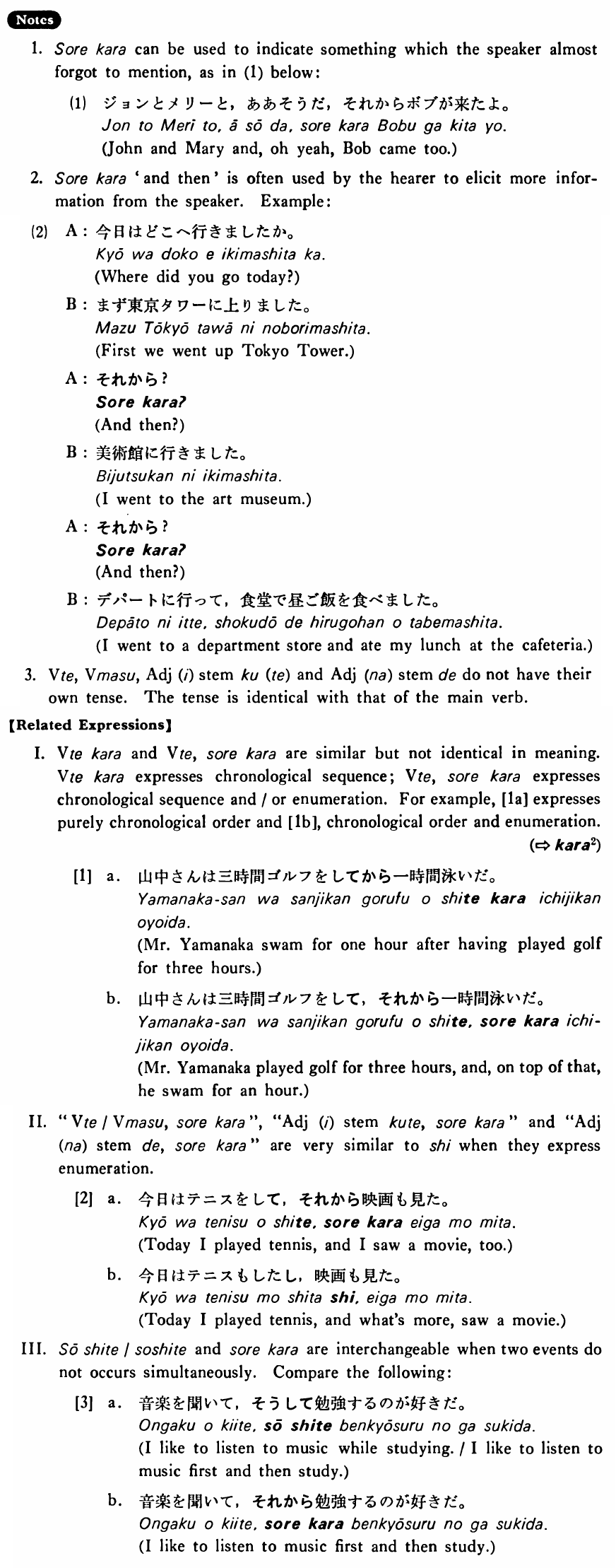
1. それから can be used to indicate something which the speaker almost forgot to mention, as in (1) below:
2. それから 'and then' is often used by the hearer to elicit more information from the speaker, example:
3. Verbて, Verbます, Adjectiveい stemく(て) and Adjectiveな stemで do not have their own tense. The tense is identical with that of the main verb.
【Related Expressions】
1. Verbてから and Verbて、それから are similar but not identical in meaning. Verbてから expresses chronological sequence; Verbて、それから expresses chronological sequence and/or enumeration. For example, [1a] expresses purely chronological order and [1b], chronological order and enumeration.
(⇨ から2)
[1]
II. "Verbて/Verbます、それから", "Adjectiveい stemくて、それから" and "Adjectiveなstemで、それから" are very similar to し when they express enumeration.
[2]
III. そうして/そして and それから are interchangeable when two events do not occurs simultaneously. Compare the following:
[3]